Identifying Red Dwarf Stars via UKIDSS
The paper by West el al (2011) "The Sloan Digital Sky Survey Data Release 7 Spectroscopic M Dwarf Catalog I: Data" (http://arxiv.org/abs/1101.1082) contains information on over 70,000 positively identified M dwarfs from the seventh data release of the Sloan Digital Sky Survey (SDSS). The positional imformation on these stars was used as an input file for the UKIDSS catalogue to see how these known red dwarfs were characterised in the results. The UKIDSS survey covered 4000 square degrees of the northern sky at high galactic latitudes in four bands: Y(1.0um) J(1.2um) H(1.6um) and K(2.2um).
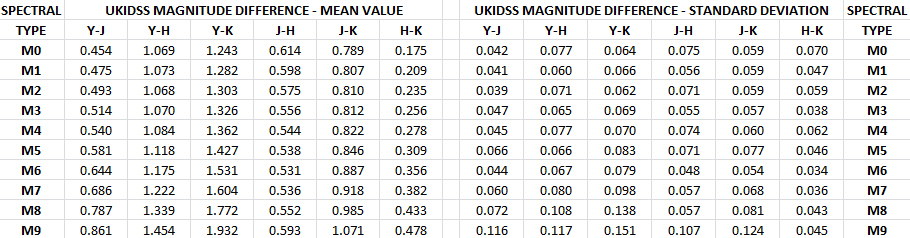
Y-J - A factor of 1.9 in the difference between a M0 and a M9 red dwarf star.
Y-H - A factor of 1.2 in the difference between a M0 and a M9 red dwarf star.
Y-K - A factor of 1.6 in the difference between a M0 and a M9 red dwarf star.
J-H - Is not a valid diagnostic test to distinguish between the sub types.
J-K - A factor of 1.4 in the difference between a M0 and a M9 red dwarf star.
H-K - A factor of 2.7 in the difference between a M0 and a M9 red dwarf star.
It would appear that a (Y-J) v (H-K) colour-colour diagram would be a valid diagnostic tool to distinguish between the various sub-types of stars already known to be red dwarfs. It should also be able to predict with some confidence when a star is not a red dwarf (it would lie outside the bounds of the colour-colour diagram for known red dwarfs). What it is not possible to say - based on the (Y-J) v (H-K) colour-colour diagram -is that a star is a red dwarf unless there is some additional supporting evidence. This might include proper motion or SDSS photometry.
This is a manifestation of what I call the "all birds have two legs but not everything with two legs is a bird" principle. All red dwarfs lie within clearly defined parts of the global colour-colour diagram but so do other types of astronomical objects!
Candidate late M type red dwarf stars extracted from UKIDSS data (23MB) - download.
A total of 237,000+ objects that fell within narrow colour-colour constraints and that were at least 99% sure to be a star.
These candidate late M type red dwarf stars as presented in SDSS data (13MB) - download.
75,000+ of these had reliable photometric data in SDSS. The average spectral class was somewhat earlier (typically M6) than I had expected.
These candidate late M type red dwarf stars as presented in Skiff data (0.1MB) - download.
Previous papers had listed spectral class information on over 1,800 of the candidates. Almost all were late type red dwarf stars.
These candidate late M type red dwarf stars as presented in UCAC4 data (0.1MB) - download.
Although disappointing few of the candidates appear in UCAC4 - being too faint - it is encouraging that many of those that do appear have a total proper motion typical of a nearby red dwarf star.
These candidate late M type red dwarf stars as presented in WISE data (4MB) - download.
Over 45,000 of the stars display similar characteristics to those shown by known red dwarf stars.
This page was initially uploaded on September 2nd 2012. Additional information was added on September 4th 2012.
Martin Nicholson - Ticklerton, Shropshire, United Kingdom