Identifying Red Dwarf Stars in the Wide-field Infrared Survey Explorer (WISE) data
For information on the WISE mission and to access the results visit this web site. In summary WISE used a 40cm telescope to map the sky at 3.4, 4.6, 12, and 22 µm in 2010 with an angular resolution of 6.1" 6.4" 6.5" and 12.0" in the four bands with saturation impacting on photometry for sources brighter than magnitudes approximately 8.0, 6.7, 3.8 and -0.4.
The paper by West el al (2011) "The Sloan Digital Sky Survey Data Release 7 Spectroscopic M Dwarf Catalog I: Data" (http://arxiv.org/abs/1101.1082) contains information on over 70,000 positively identified M dwarfs from the seventh data release of the Sloan Digital Sky Survey (SDSS). The positional imformation on these stars was used as an input file for the WISE catalogue to see how these known red dwarfs were characterised in the WISE results.
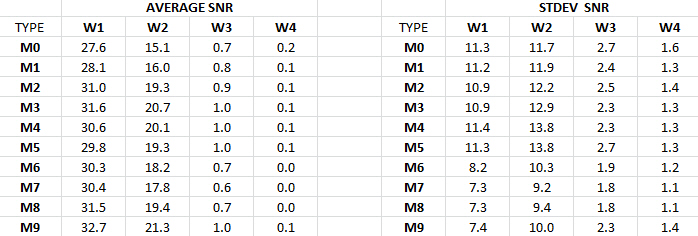
Although there is no significant difference in the average signal to noise ratio (SNR) between the sub-types of M dwarf stars in any one wave band there are massive differences between the bands. For example when searching for potential M dwarf stars any star with a SNR > 10 in either the W3 or W4 band can safely be discounted.
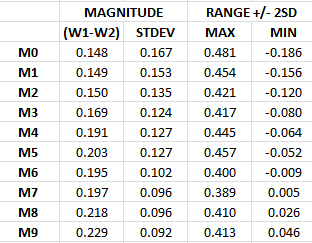
Another possible filter is the value of the (W1-W2) magnitude. If the measured value is below -0.2 or above 0.5 the star is very unlikely to be a M dwarf star.
This page was last updated on August 30th 2012.
Martin Nicholson - Ticklerton, Shropshire, United Kingdom