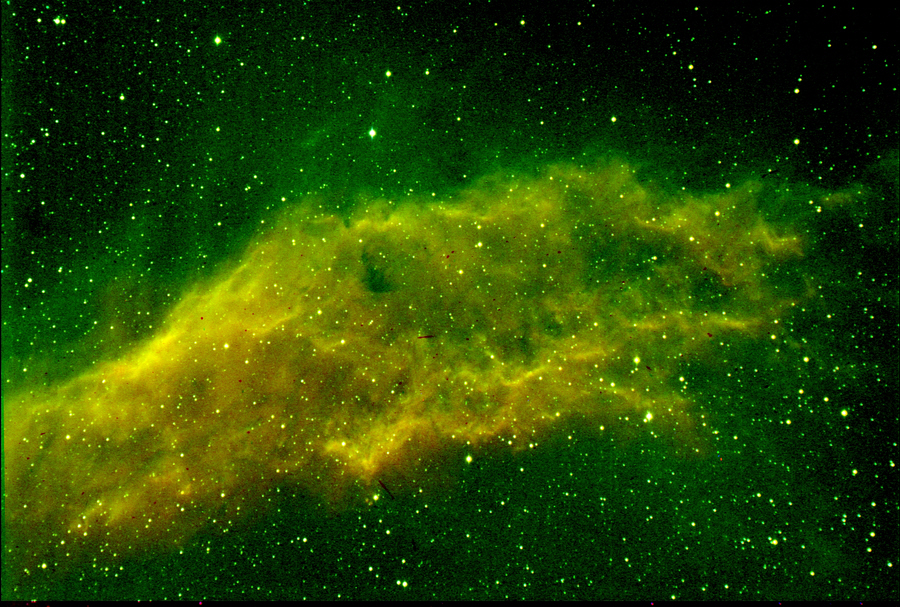
NGC 1499 - an emission nebula in Perseus
The California Nebula NGC 1499 was discovered by E.E. Barnard in about 1884-5. Its low surface brightness and large size make it a difficult target even for wide field scopes. The main emission line of the nebula is Hydrogen Alpha, that is hydrogen emitting at the wavelength 656.3 nm, at the red end of the visible light spectrum.
The image is made up from 6 x 5 minutes Hydrogen Alpha (Red), 6 x 5 minutes SII (Green) and 6 x 5 minutes OIII (Blue)
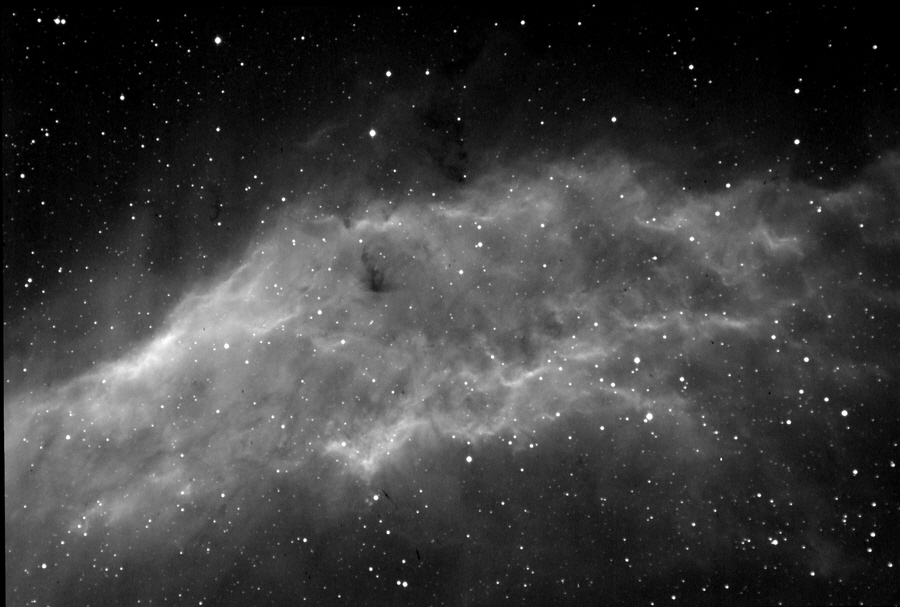
The image is made up from 12 x 5 minutes Hydrogen Alpha
Martin Nicholson - Daventry, United Kingdom.
This page was last updated on April 26th 2009.