Page 1 Why Infra-Red Astronomy? - Page 2 Investigating possible projects - Page 3 Variable stars in the field of OO VUL - Page 4 The final project design
|
Link - IR Astronomy: An overview including a wide range of IR resources. |
Project 1a - Generation of initial target lists and supporting documentation for projects
The easiest place to identify very red (M8, M9 or M10) stars is by searching the Catalogue of Stellar Spectral Classifications (Skiff, 2007). This generates many potential targets and I selected the M9 star AT AUR almost at random.
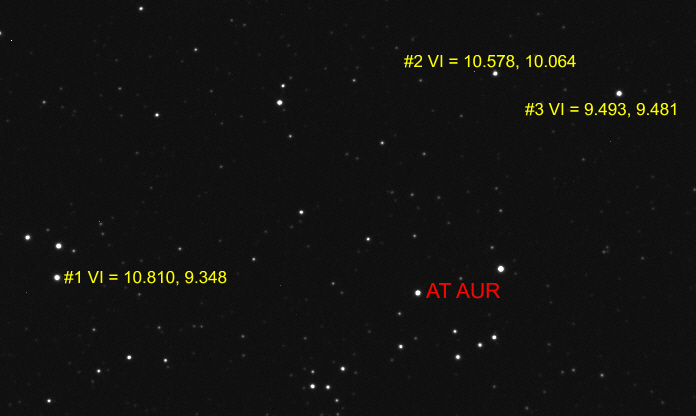
Any project intended to examine red variable stars in both the IR and V bands requires two sets of comparison star magnitudes. I can obtain these from the TASS Mark IV patches photometric catalog, version 2 (Droege+, 2007). This enables me to create a finder chart with all the key data in one place. This specimen chart measures 25 x 15 arc minutes
AT AUR FINDER CHART
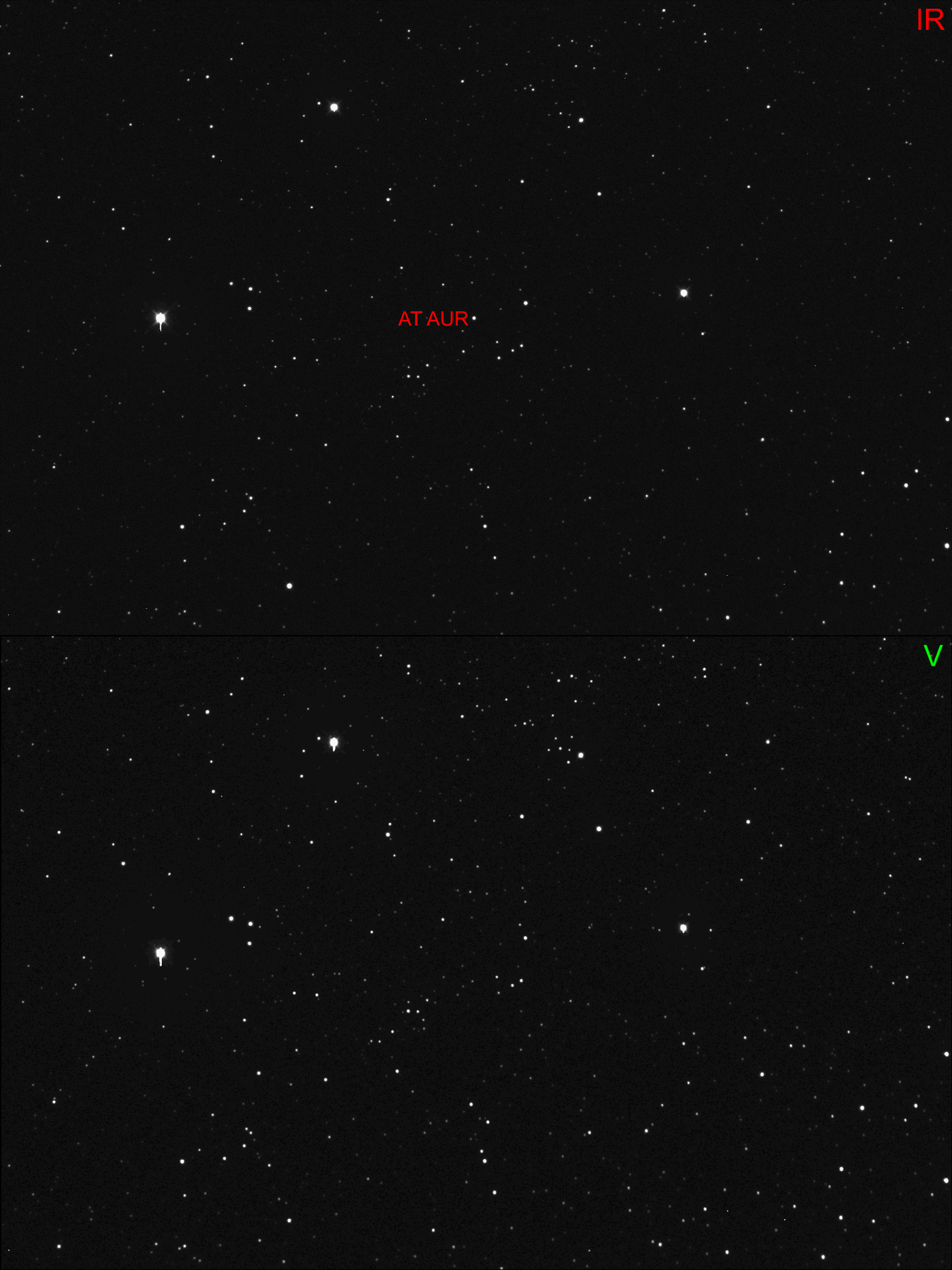
The first set of images were taken with an exposures of 60 seconds in IR and 120 seconds in V. The aim here is to obtain a reasonable signal to noise ratio - as needed for subsequent high quality photometry - without any blooming of the image.
Once processed (bias, dark and flat) measuring the magnitude is a routine process using MaxIm DL. The trial run generated an I band magnitude of 9.28 and a V band magnitude of 15.09 with the V-I value of 5.81 being typical of a M8/M9 star.
AT AUR PROCESSED IMAGE - (reduced by 25% for convenience)
Project 1b - Expanding and fine tuning the project
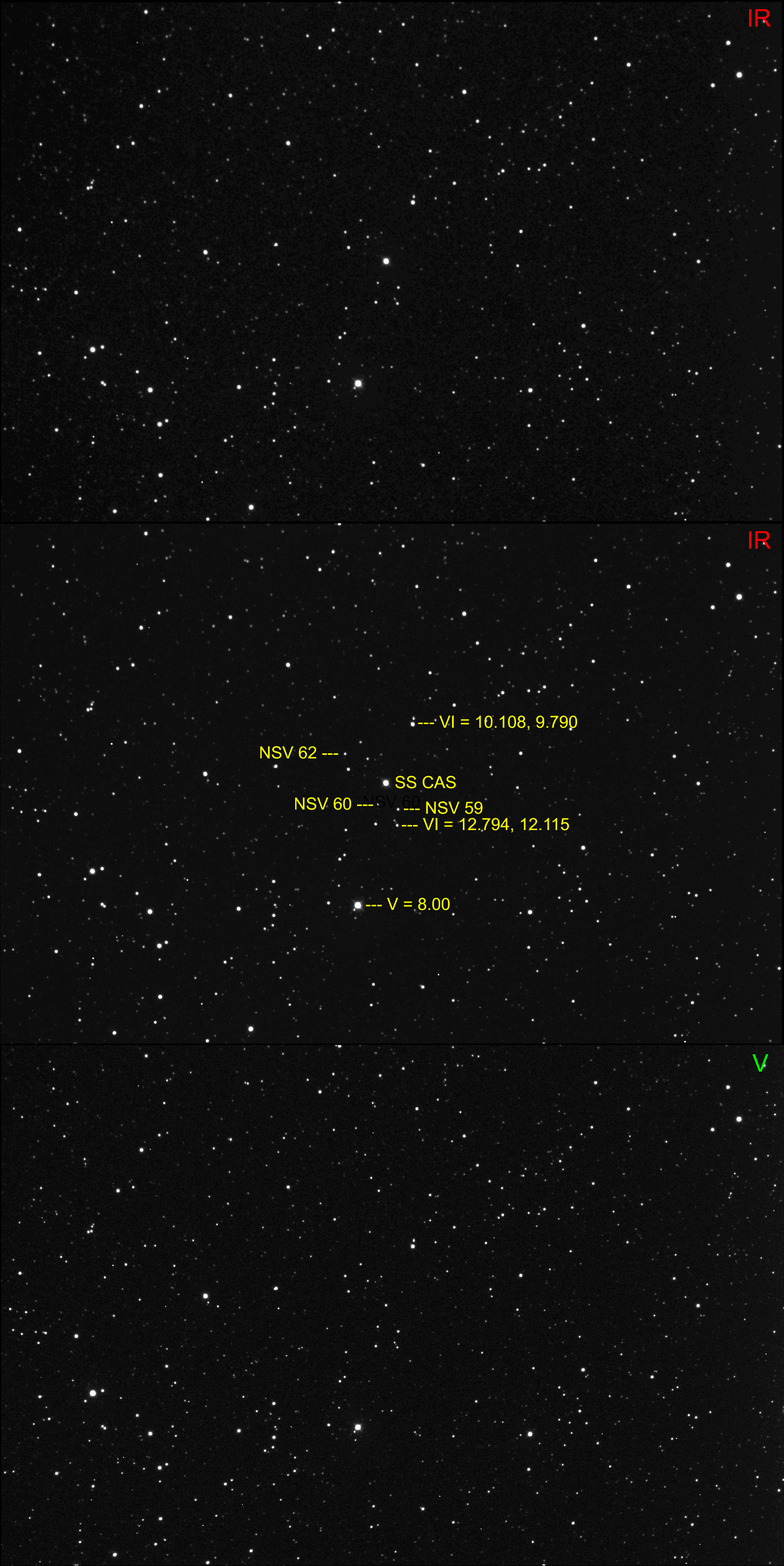
Some of the possible target stars had the added bonus of having other previously known variables in the same field of view. Other targets had a number of IR bright and V faint stars close by. This meant that including stars such as SS CAS in the project offers clear productivity gains.
SS CAS PROCESSED IMAGE - (reduced by 25% for convenience)
Added Targets
| STAR | IR EXPOSURE TIME | V EXPOSURE TIME |
| TX CAM | 30s | 60s |
| SS CAS | 30s | 60s |
| Y CAS | 30s | 60s |
| UZ LAC | 120s | 120s |
| FU PER | 120s | 120s |
Page 1 Why Infra-Red Astronomy? - Page 2 Investigating possible projects - Page 3 Variable stars in the field of OO VUL - Page 4 The final project design
In collaboration with the Remote Astronomical Society Observatory
Martin Nicholson - Daventry, United Kingdom.
This page was last updated on October 4th 2008.